⚠️ Affiliate Disclosure: This post is not an affiliate associated review. It may become one in the future and this disclosure will reflect that. This does not affect my reviews and I only recommend tools I genuinely believe in.
These UK AI statistics come from official sources, mainly the Office for National Statistics (ONS), and every figure has a date and a link to where it came from. This page covers how many UK businesses use AI, which AI tools they use, how AI is affecting jobs, and what AI tools cost in pounds, plus my own hands-on test scores.
Key Takeaways
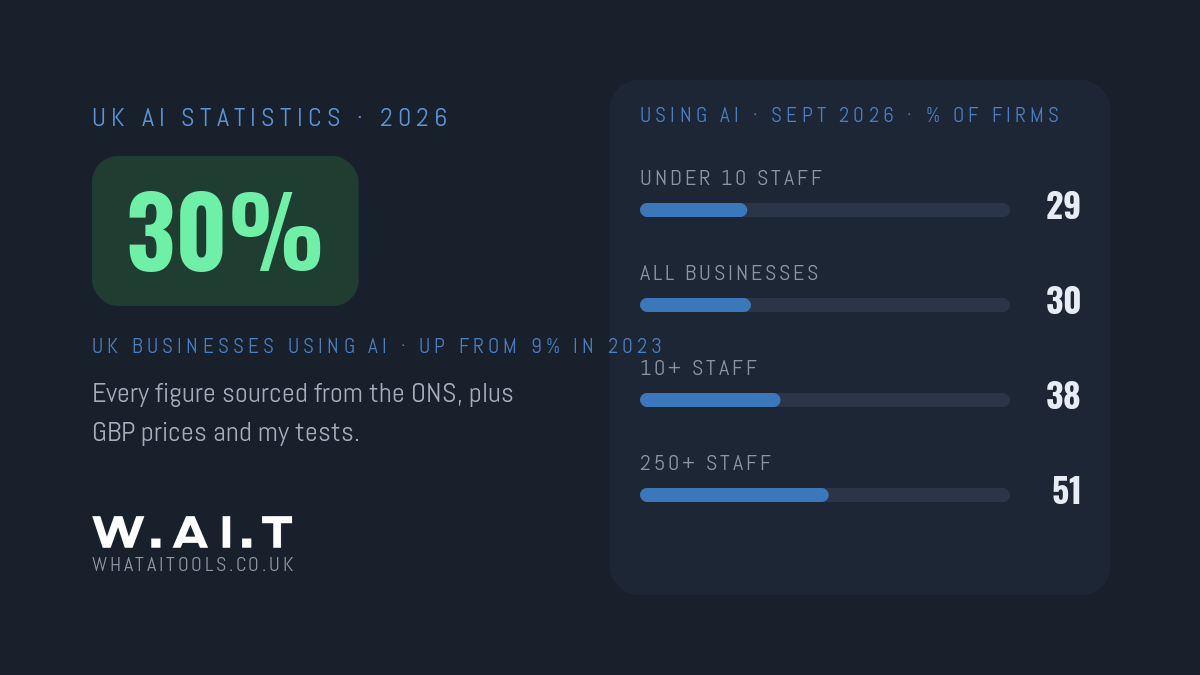
- 30% of UK businesses used AI in September 2026, up from 9% in September 2023 (ONS).
- Bigger businesses use AI more: 38% of businesses with 10 or more employees, 51% of the largest, but 29% of those with fewer than 10.
- Chatbots and image tools lead: 21% of businesses with 10+ staff use AI text generation and 19% use AI for visual content.
- Few job cuts so far: 6% of AI-using businesses with 10+ staff said AI reduced their headcount.
- Worry is rising: 12% of businesses with 10+ staff were concerned about AI affecting their supply chains in October 2026, the highest since ONS started asking.
- Most UK businesses still don’t use AI, so treat claims that “most UK businesses use AI” with care.
What Are the Key UK AI Statistics at a Glance?
| Statistic | Figure | Who it covers | Period | Source |
|---|---|---|---|---|
| Businesses using at least one AI technology | 30% | All UK businesses | September 2026 (survey live 21 Sept to 4 Oct 2026) | ONS BICS, 8 Oct 2026 |
| The same measure when ONS first asked | 9% | All UK businesses | September 2023 | ONS BICS, 8 Oct 2026 |
| Businesses using AI | 38% | Businesses with 10 or more employees | September 2026 | ONS BICS, 8 Oct 2026 |
| Businesses using AI | 29% | Businesses with fewer than 10 employees | September 2026 | ONS BICS, 8 Oct 2026 |
| Businesses using AI | 51% | Large businesses (see the note on size bands below) | September 2026 | ONS BICS, 8 Oct 2026 |
| Using text generation with large language models | 21% | Businesses with 10 or more employees | September 2026 | ONS BICS, 8 Oct 2026 |
| Using AI for visual content creation | 19% | Businesses with 10 or more employees | September 2026 | ONS BICS, 8 Oct 2026 |
| AI use in information and communication | 60% | Businesses in the information and communication industry | September 2026 | ONS BICS, 8 Oct 2026 |
| Say admin and clerical roles were most affected by AI | 38% | Businesses with 10 or more employees that use AI | September 2026 | ONS BICS, 8 Oct 2026 |
| Cut headcount because of AI | 6% | Businesses with 10 or more employees that use AI | September 2026 | ONS BICS, 8 Oct 2026 |
| Worried about AI affecting their supply chains | 12% | Businesses with 10 or more employees | October 2026 (survey live 19 Oct to 1 Nov 2026) | ONS BICS, 5 Nov 2026 |
What Share of UK Businesses Use AI in 2026?
In September 2026, 30% of UK businesses said they used at least one type of AI technology. ONS says this was broadly unchanged from June 2026, and 20 percentage points higher than in September 2023, when the question was first asked and the figure was 9%. Source: ONS, Business insights and impact on the UK economy, 8 October 2026 (BICS Wave 165, live 21 September to 4 October 2026).
So most UK businesses still don’t use AI. That’s worth knowing, because some sites quote much higher numbers, often from surveys of large firms or of people already interested in AI. If a figure says most UK businesses use AI, check who was asked and when.
How Does AI Use Differ by UK Business Size?
Larger UK businesses use AI more. These figures are for September 2026, from the same ONS bulletin of 8 October 2026:
- Fewer than 10 employees: 29% use AI.
- 10 or more employees: 38% use AI, up 3 percentage points from June 2026 and 26 points from September 2023.
- Large businesses: 51% use AI.
A note on the 51% figure: the bulletin’s main points and its Figure 1 give 51% for businesses with 250 or more employees, up from 19% in September 2023. The AI section of the same bulletin gives 51% for businesses with 100 or more employees. If you quote this figure, check the ONS dataset to see which size band you mean.
For sole traders and small businesses, the 29% figure means you’re not behind if you haven’t started. The cheapest way in is a free chatbot plan: ChatGPT, Claude and Gemini all have one, and I cover the paid options in my UK AI subscription prices guide. My best AI tools for small business guide ranks the tools I’ve tested for small firms.
Which AI Tools Are UK Businesses Using Most?
For UK businesses with 10 or more employees in September 2026, the most common AI uses were:
- Text generation using large language models: 21%, up 16 percentage points since September 2023.
- Visual content creation: 19%, up 15 percentage points since September 2023.
Source: ONS, 8 October 2026. ONS doesn’t name products. Text generation covers chatbots and writing assistants like those in my best AI chatbots and best AI writing tools guides. Visual content creation covers image and video tools such as those in my Canva Magic Studio and Midjourney reviews and my best AI video tools guide.
Which UK Industries Use AI Most?
The information and communication industry had the highest rate of AI use in the UK. Around 60% of these businesses said they were using an AI technology in September 2026, the highest of any industry surveyed. Source: ONS, 8 October 2026.
How Is AI Affecting Jobs in UK Businesses?
ONS asked UK businesses with 10 or more employees that use AI which roles were most affected. These are the September 2026 results from the 8 October 2026 bulletin:
- Admin and clerical roles: 38% named these as most affected, up 3 percentage points from June 2026 and 9 points from December 2025, when ONS first asked.
- Creative and design roles: 24%, broadly unchanged since December 2025.
On headcount, 6% of these businesses said AI had led to fewer staff, and fewer than 1% said it had led to more. ONS says both figures have been broadly stable over the last year.
Are UK Businesses Worried About AI?
In October 2026, 12% of UK businesses with 10 or more employees said they were worried about AI affecting their supply chains over the next 12 months. That was up from 5% in September 2026, and the highest level since ONS started asking in September 2024. For comparison, 21% were worried about cyber attacks affecting supply chains, also a record. Source: ONS, Business insights and impact on the UK economy, 5 November 2026 (BICS Wave 167, live 19 October to 1 November 2026).
What Do AI Tools Cost in the UK in Pounds?
Most AI tools list prices in US dollars, but UK buyers often see a different price in pounds, and it may or may not include VAT. These are the main standard plans as shown to UK buyers:
| Tool and plan | Monthly price (GBP) | Includes VAT? | Annual option (GBP) | Date checked |
|---|---|---|---|---|
| ChatGPT Plus | £20 | Yes, 20% | None shown | 16 Nov 2026 |
| Claude Pro | £18 | Yes, 20% | £180 a year (£15 a month) | 16 Nov 2026 |
| Google AI Pro (Gemini) | £18.99 | Yes, 20% | None shown | 16 Nov 2026 |
| Microsoft 365 Personal with Copilot | £8.49 | Not stated | £84.99 a year | 16 Nov 2026 |
| Grok Premium | £26 | No, before tax | Not checked | 16 Nov 2026 |
Perplexity and Mistral show UK visitors US dollar prices only, and Grok’s pounds prices exclude tax, so the price you see isn’t always the price you pay.
What Did My Hands-On Tests Find?
I sign up for and test every tool I review on WhatAITools by hand. These are my scores for the AI chatbots most UK businesses will be choosing between:
| Tool | My score | Best for | Full review |
|---|---|---|---|
| ChatGPT | 9/10 | All-round use | ChatGPT review |
| Claude | 9/10 | Writing | Claude AI review |
| Perplexity | 9/10 | Research with sources | Perplexity review |
| Grok | 7/10 | Heavy X users | Grok review |
How I score: each tool is tested on my own accounts, on the plans I say in the review, and scored out of 10 on output quality, ease of use, features and value for money, with an overall score that’s my own judgement rather than an average. The full method is on my how I test page.
How Reliable Are These UK AI Statistics?
- Official statistics in development: ONS calls its BICS figures “official statistics in development” and advises caution when using them.
- A voluntary survey: BICS is voluntary and runs every two weeks. ONS often adds, removes or changes questions, so not every topic is covered in every wave. Around 26% of sampled businesses responded to the September 2026 wave.
- Estimates with a margin of error: ONS publishes confidence intervals alongside the data.
- Not every business is covered: BICS surveys private sector businesses and leaves out some industries, including agriculture, finance and insurance, and public sector education and health.
- Different bases: some figures cover all businesses, others only businesses with 10 or more employees. Check which one you’re quoting.
Source for these notes: ONS, 5 November 2026 and ONS, 8 October 2026.
How Should You Cite This Page?
If you use my test scores or GBP prices, please cite this page:
Huntington, J. (2026). UK AI Statistics 2026. WhatAITools.co.uk. Updated 16 November 2026. https://whataitools.co.uk/uk-ai-statistics/
For the ONS figures, it’s best to cite ONS directly as well, using the bulletin date and survey period given next to each figure above.
Frequently Asked Questions
What percentage of UK businesses use AI?
30% of UK businesses used at least one AI technology in September 2026, according to ONS. For businesses with 10 or more employees, the figure was 38%. Source: ONS, 8 October 2026.
Is AI cutting jobs in UK businesses?
Not by much so far. In September 2026, 6% of UK businesses with 10 or more employees that use AI said it had reduced their headcount, and fewer than 1% said it had increased it. Admin and clerical roles were the most often named as affected. Source: ONS, 8 October 2026.
Do small UK businesses use AI?
Fewer of them do. In September 2026, 29% of UK businesses with fewer than 10 employees used AI, compared with around half of large businesses. Source: ONS, 8 October 2026.
Which UK industry uses AI the most?
Information and communication. Around 60% of UK businesses in that industry used an AI technology in September 2026, the highest of any industry ONS surveyed.
More from WhatAITools: AI subscription prices UK, best AI tools for small business, best AI chatbots and AI glossary.

James is an SEO and content specialist with over 12 years’ experience, and tests AI tools so everyday people don’t have to. WhatAITools.co.uk covers honest, no-jargon reviews to help you find the right tool for your needs.
Leave a Reply