⚠️ Affiliate Disclosure: This post is not an affiliate associated review. It may become one in the future and this disclosure will reflect that. This does not affect my reviews and I only recommend tools I genuinely believe in.
Net Entropy Score Review
This Net Entropy Score Review covers the free Scanner and Sentinel monitoring tool, the MCP connector that lets Claude or ChatGPT pull a live brand consistency check mid-conversation, and whether the paid diagnostics are worth the price for business owners and marketing teams.
I had Net Entropy Score (NES) in my “AI Tools I Looked At (But Didn’t Review)” list earlier this year. Since then the dataset has grown from 650 reads to a benchmark of 1,600+ brands and 2,600+ reads (NES’s own figures, November 2026), the Sentinel monitoring product has launched free, and, according to NES, anonymous AI agents now run 100+ brand checks a day through its MCP API. Time to give it a proper verdict.
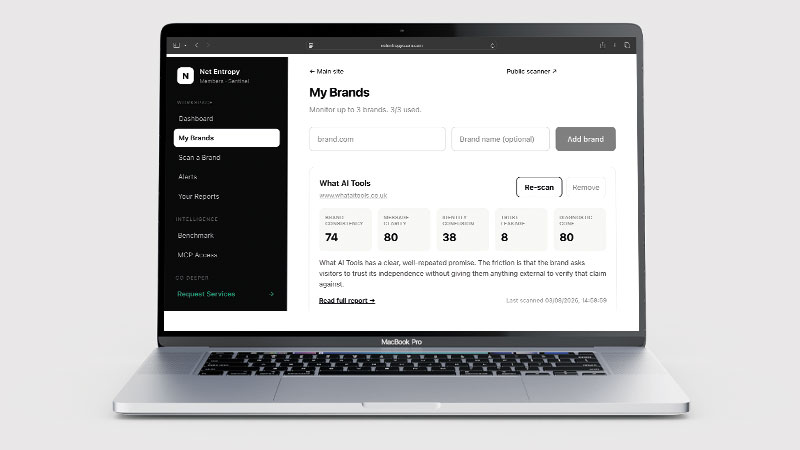
Net Entropy Score is an AI brand consistency measurement tool that turns public signals — website content, reviews, news — into a structured score from −100 to +100. The free Scanner runs in two minutes with no login required. NES Sentinel adds weekly automated re-reads and drift alerts at no cost during early access. And for regular readers of this site: NES ships an MCP connector, meaning Claude or ChatGPT can pull a live brand consistency check on any company mid-conversation, just by being asked.
What is Net Entropy Score?
NES is a brand consistency measurement framework built by Pankaj Upadhyay, a Dubai-based founder with nine years across consumer brands in DTC, FMCG, SaaS, and hospitality. The core idea: standard metrics like NPS and star ratings average your customer base. NES measures how consistently a brand delivers its promise — and where that consistency breaks down.
The methodology is published on SSRN (Abstract ID: 6667158) and classifies customer signals into five experience bands:
| Band | Score range | What it means |
|---|---|---|
| Coherent | 9–10 | Highly consistent experience, reliably reproduced |
| Reliable | 7–8 | Mostly consistent, minor variation doesn’t break trust |
| Variable | 5–6 | Noticeable variation, lacks a stable core |
| Scattered | 3–4 | Significant variation, experience becomes unpredictable |
| Disordered | 0–2 | Highly inconsistent, feels chaotic or contradictory |
The overall NES score is calculated as: NES = % Coherent − % (Scattered + Disordered), giving a bounded number from −100 to +100. The AI production layer uses a BART-MNLI zero-shot classification model to process public review text into those bands — making the inferred tier fast and affordable without needing direct customer surveys.
What Can You Do With Net Entropy Score?
- Run a free instant scan. The public Scanner at scanner.netentropyscore.com reads any brand’s website against five consistency metrics in about two minutes. No login, no email, no card. You get scores across Brand Consistency, Message Clarity, Identity Confusion, Trust Leakage, and Diagnostic Confidence — each with specific on-page observations.
- Set up weekly monitoring with Sentinel. NES Sentinel is free during early access and runs automated re-reads on up to three brands every week. You get a drift alert the moment any score moves more than 5 points — telling you the direction, the delta, and the biggest driver. Quiet weeks send nothing. You can monitor your own brand, a competitor, and a client simultaneously. Sentinel benchmarks your scores against 1,600+ brands so you can see the percentile your brand sits at in context.
-
Connect your AI via MCP. NES ships an MCP connector at
api.netentropyscore.com/mcp, listed on the official MCP registry. Add it to Claude, ChatGPT, or Cursor in two minutes, then ask “hey Claude, using NES, tell me about [brand]” and get a claim-vs-reality read mid-conversation on any brand NES has already scanned. If you’d rather skip the connector setup, there’s a one-line custom instruction you can paste into any AI’s settings instead — same data, no configuration required. - Order a deeper paid diagnostic. The free Scanner is the first tier (Predicted NES from public signals). For a full Review-Inferred NES — where the AI classifies your actual review corpus into consistency bands by channel and cohort — that’s a paid diagnostic. The Measured tier, using direct customer surveys and behavioural data, is the gold standard and is priced for enterprise engagements.
Net Entropy Score Pricing
| Product | Price | What you get |
|---|---|---|
| Free Scanner | Free, no login | 5 consistency scores on any brand website, instant |
| AI Brand Visibility Report | $29, one-time | What ChatGPT, Claude and Gemini say about your brand |
| Full Website Audit | $49, one-time | Deep PDF in about 3 minutes: all 5 scores, a 10-component breakdown and a top 5 fix list |
| Sentinel Monitoring | Free (early access) | Weekly re-reads, 3 brands, drift alerts, MCP access, 3 team seats |
| Claim-vs-Reality Diagnostic | $778 | What you say vs what customers feel, quantified |
| Review-Inferred Diagnostic | $2,399 | 18-page report, channel & cohort analysis, 7-day delivery, 30-min call |
| Measured Engagement | Quoted per engagement | Direct surveys, cohort analysis, quarterly remeasurement |
NES now has a middle step: after the $29 and $49 one-off reports comes a $778 Claim-vs-Reality Diagnostic, then the $2,399 Review-Inferred report. Measured NES and done-for-you work are quoted per engagement. For most small business owners, the free Scanner and Sentinel will be the main touchpoints — and they’re genuinely useful at that level. Check NES’s pricing page for current details as the product is in active development.
Net Entropy Score Review: Pros and Cons
Net Entropy Score Pros
- Free Scanner with no login or card required — genuinely useful out of the box
- Sentinel weekly monitoring is free during early access — no card, 3 brands, 3 team seats
- MCP connector for Claude, ChatGPT, and Cursor — live brand checks mid-conversation
- Five plain-language scores rather than a single opaque number
- Published academic methodology on SSRN — unusual transparency for an early-stage tool
- Drift alerts only fire when scores move more than 5 points — no noise in quiet weeks
- 1,600+ brand benchmark dataset for percentile context
- Chrome extension for on-demand scanning as you browse
Net Entropy Score Cons
- Methodology is explicitly exploratory — the working paper notes statistical validation is future work
- Paid reports climb fast: $29 and $49 one-offs, then $778 and $2,399 for the deeper diagnostics
- Deep diagnostics ($778 and $2,399, with Measured work quoted per engagement) are out of reach for most small businesses
- Public-signal coverage only — brands with thin digital footprints get narrower reads
- Early-stage product: features, pricing, and coverage are still evolving
- The MCP connector only returns brands NES has already scanned — 7 of the 16 I tried were not tracked, and some reads were months old
- Looking a brand up by name can return the wrong company — use the web address
- No mobile app; web-only dashboard
Who Is Net Entropy Score For?
NES is a good fit for founders and business owners who want a fast, structured read on whether their brand’s public presence holds together — and a weekly signal if it starts slipping. It works well for marketing and brand managers who want to track a competitor’s drift alongside their own score. Investors and analysts doing pre-meeting due diligence will find the MCP connector particularly useful: ask Claude to check a company’s brand consistency before a call without leaving the conversation.
It’s less suited to enterprise brand teams who need the social listening scale of tools like Brandwatch or Sprout Social, or to businesses whose primary customer signals live offline rather than in public digital reviews.
Key Use Cases
Founders doing a monthly brand health check. Most founders have no structured way to check whether their brand’s public presence is holding together. NES gives you five scored dimensions on demand and a weekly automated re-read if anything drifts. Free, takes two minutes, no commitment required.
Marketing teams tracking a competitor move. When a competitor changes positioning, launches a new product line, or gets into a PR incident, NES gives you a rapid read on whether their public brand consistency is holding or leaking — benchmarked against the 1,600+ brand dataset.
AI-forward teams using Claude or ChatGPT for research. The MCP connector makes NES a practical addition to any agentic research workflow. Ask Claude to check a company’s brand consistency as part of a competitor analysis, investor memo, or client brief — without switching tabs. NES says anonymous AI agents already do this, running 100+ brand checks a day through its API.
The Net Entropy Score MCP Connector: What I Found Testing It
I connected the Net Entropy Score MCP connector to Claude and ran 18 lookups across 16 brands: WhatAITools itself, tools I have reviewed, and big names such as OpenAI and Canva. Here is what the NES connector actually does.
What can the Net Entropy Score MCP connector do?
- Check one brand — the NES connector returns that brand’s stored website score, recent news and a “divergence” reading
- Compare up to eight brands side by side; NES presents the data but deliberately does not recommend one
- Read only — the NES connector cannot change anything, which makes it safe to connect
What information does the Net Entropy Score MCP give you?
Each Net Entropy Score result has three parts. The claim is a website brand consistency score from 0 to 100, with message clarity, identity confusion, trust leakage risk, a confidence figure and a one-line summary. The reality side lists dated news events from the last 90 days, each tagged by type and severity. The divergence score rises when a brand’s website looks coherent while its news turns negative. Every result carries a clear disclaimer that it is a directional estimate, not a fraud or financial check.
| Brand | Website score (0–100) | Read dated | News events (90 days) | Divergence |
|---|---|---|---|---|
| WhatAITools | 77 | 5 Oct 2026 | 0 | 0 (aligned) |
| Make | 72 | 13 Oct 2026 | 0 | 0 (aligned) |
| Suno | 72 | 16 Jul 2026 | 1 | 2.2 |
| Anthropic | 70 | 26 Sep 2026 | 8 | 4.2 |
| Canva | 63 | 7 Aug 2026 | 0 | 0 (aligned) |
| OpenAI | 60 | 26 Jul 2026 | 8 | 16.8 |
The read on my own site was genuinely useful. NES scored WhatAITools 77/100 and summed it up as a clear, consistent editorial identity whose independence claim is “entirely self-asserted, with no visible third-party validation” — fair criticism, and something I can act on.
When I checked again on 3 November, after a live re-scan that worked, WhatAITools had moved to 78/100 with a rewritten summary that still made the same point about outside validation. Anthropic had a fresh 26 October read at 74 with a divergence of 0. OpenAI’s website read was still from July, but its divergence had fallen from 16.8 to 12 as its news changed.
What can’t the Net Entropy Score MCP do?
- It is not live by default. The NES connector returns the last stored scan, and some were months old — Canva’s read still dates from 7 August and Suno’s from 16 July. Only the news side updates on its own.
- A “live re-scan” refreshes the read, but not reliably. When I pressed Live re-scan on WhatAITools in my NES dashboard on 14 October, the timestamp changed to “just now” but every score (77, 85, 30, 6, 80) and the full report text came back identical to the 5 October read — still recommending a Reddit community I had already removed from the site — and the MCP connector kept serving the 5 October date. When I tried again on 3 November, it worked: within about three minutes both the dashboard and the connector showed a fresh read, with the score up from 77 to 78 and a rewritten summary. If a brand matters to you, re-scan it before you trust the connector’s answer.
- It cannot scan a new brand. For a brand NES has never read, the connector replies “no read on file” and links you to the web Scanner instead.
- Coverage of smaller AI tools is thin. Seven of the 16 brands I tried were not tracked, including Perplexity, Udio, fonio.ai and Telli — exactly the kind of tools this site reviews. On 3 November all four were still missing, and so were Gamma and Grammarly.
- Name lookups can pick the wrong brand. Searching for “Udio” by name returned an unrelated company, First Draft Studio, with no warning, and Zapier came back labelled “Pie”. On 3 November, searching “WhatAITools” by name returned “no read on file” even though my site had a read, and Zapier by name returned a May read while its web address returned an August one. Always look brands up by web address.
Is the Net Entropy Score MCP connector useful?
Yes, within limits. The Net Entropy Score MCP connector is a quick, safe way to sanity-check a well-known brand from inside Claude, and the divergence reading is a useful early warning before a partnership or a review. It is much less useful for new or niche AI tools, because most of them have not been scanned yet — and since the reads can be months old, treat the website score as a snapshot unless you have just re-scanned the brand yourself.
What Are the Downsides of Net Entropy Score?
It’s exploratory by design. The NES working paper is explicit: statistical validation, inter-rater reliability testing, and out-of-sample prediction testing are all listed as future work. The scores are directional reads, not precision metrics. Use them to open questions, not to close decisions.
Public signals only for the free tier. The free Scanner and Sentinel monitor public digital signals: website content, reviews where available, news signals. Brands with thin digital footprints get narrower reads. The Measured tier addresses this but costs significantly more.
The deeper reports get expensive quickly. NES has added a $778 Claim-vs-Reality Diagnostic between the $49 website audit and the $2,399 Review-Inferred report, which helps. But anything beyond the one-off website reports still costs hundreds of dollars, a big step for a small business that has only used the free tools.
Is Net Entropy Score Good? My Verdict
Partly — I scored Net Entropy Score 7/10 in my WhatAITools review. The free scanner is genuinely good, giving a plain-English read on brand consistency in minutes with no card required, and the MCP connector is a real differentiator. The reservations are the price of the deeper reports, which run from $778 to $2,399, and a methodology the company itself calls exploratory.
NES is doing something genuinely new: turning brand consistency measurement — previously an expensive consulting exercise — into a free, AI-assisted weekly signal any business owner can run. The free Scanner and Sentinel monitoring are the strongest value for most readers of this site. Fast, plain-English, no card required, and more structured than anything else in brand monitoring at the same price point (zero).
The MCP connector is a legitimate differentiator for AI-forward teams. Pulling a live brand consistency read into a Claude or ChatGPT conversation without switching tabs is a practical capability I have not seen in other brand monitoring tools I have reviewed — though in my test it only returned brands NES had already scanned, and some reads were months old — and the no-connector instruction-paste option means you don’t even need to configure anything to try it.
The caveats are real: it’s early-stage, the methodology is exploratory, and the deep diagnostics are out of reach for most small businesses. But the free tier is good enough to earn a place in your monthly toolkit, and setting up Sentinel before pricing arrives is a sensible move.
Best for: Founders and marketing teams who want a structured, free weekly read on their brand’s public consistency — and anyone using Claude or ChatGPT for research who wants a live brand signal baked in.
Not ideal for: Enterprise brand teams needing social listening at scale, or brands whose primary customer signals are offline.
Net Entropy Score Score Breakdown
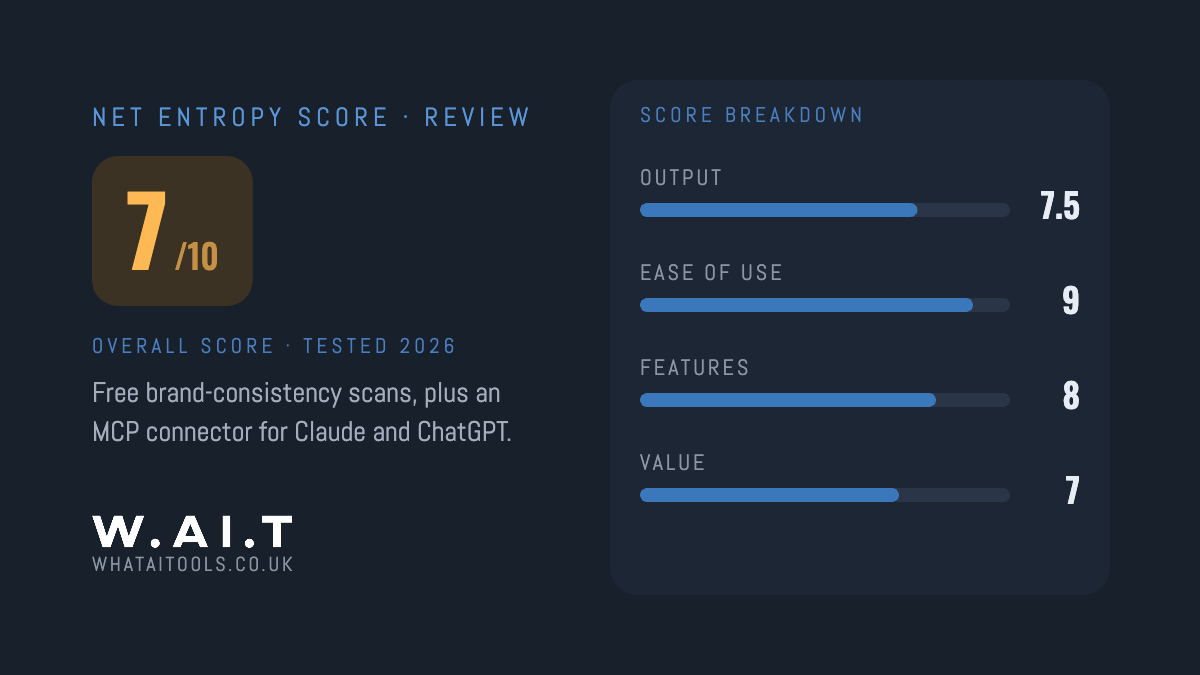
| Output quality | 7.5/10 | Plain-English brand consistency reads, but the methodology is self-described as exploratory |
| Ease of use | 9/10 | Free scanner, no card, results in minutes |
| Features | 8/10 | Scanner, Sentinel monitoring and an MCP connector for Claude and ChatGPT |
| Value for money | 7/10 | The free tier is excellent; one-off reports start at $29, but the deeper diagnostics cost $778 and $2,399 |
| Overall score | 7/10 | A genuinely useful free tool, with deeper reports that cost real money |
Net Entropy Score Review Rating: 7/10
Frequently Asked Questions
Is Net Entropy Score legit?
Yes. Net Entropy Score is a real product with a free scanner, Sentinel monitoring and an MCP connector for Claude and ChatGPT, and it does not require a card to try. Be aware that its own working paper describes the methodology as exploratory, with statistical validation still to come, so treat the numbers as directional.
Is Net Entropy Score free?
Yes — the Scanner is completely free with no login or card required. NES Sentinel (weekly monitoring on up to three brands, drift alerts, MCP access, 3 team seats) is also free during early access. Paid reports start at $29 for an AI brand visibility report and $49 for a full website audit, with a $778 Claim-vs-Reality Diagnostic and a $2,399 Review-Inferred report above that.
What are the five Net Entropy Score scores?
The Scanner measures five dimensions: Brand Consistency, Message Clarity, Identity Confusion, Trust Leakage, and Diagnostic Confidence. Each is scored separately so you can see exactly where your brand’s public presence is holding and where it’s leaking.
How accurate is Net Entropy Score?
NES is designed as a directional framework, not a precision metric. The working paper published on SSRN explicitly positions the methodology as exploratory — statistical validation and out-of-sample testing remain future work. Treat the scores as a structured starting point for investigation, not a definitive brand health verdict.
What is the Net Entropy Score MCP connector?
NES provides an MCP (Model Context Protocol) server at api.netentropyscore.com/mcp, listed on the official MCP registry. Adding it to Claude, ChatGPT, or Cursor lets you ask about any brand’s consistency directly mid-conversation. There’s also a no-connector option: paste a single custom instruction into your AI’s settings and it will call the NES API whenever you ask about a brand’s trust or consistency. In my test, the connector only returned brands NES had already scanned, and it cannot run a new scan for you.
What is the Convergence Gap?
The Convergence Gap is the difference between Predicted NES (what public signals suggest about a brand) and Measured NES (what actual customers say). A gap above +15 means public perception may be overstating real experience — a risk signal. A gap below −15 means the brand is stronger in reality than it looks publicly — hidden strength. NES treats this gap as the core diagnostic finding.
Net Entropy Score Alternatives Worth Considering
📊 Brandwatch
Best for enterprise social listening at scale — Brandwatch monitors millions of mentions across social platforms and news. Much more expensive and complex than NES, but covers real-time social channels that NES’s public-signal scanner doesn’t reach.
📈 Mention
Best for straightforward brand mention tracking — Mention monitors where your brand appears online and in the news. Less analytical than NES (no consistency scoring or five-band classification), but broader in social coverage and more affordable for small teams.
🔍 Semrush
Best if your primary concern is search visibility rather than brand consistency — Semrush tracks keyword rankings, backlinks, and competitor SEO. A different angle from NES’s consistency measurement, but often used alongside it for a fuller picture of a brand’s digital health.
More from WhatAITools: MindStudio review, Lindy review and Native.no review.
Every tool I review is signed up for and tested by hand. See how I test and score.
See how Net Entropy Score compares with the other AI visibility tools I’ve tested in my best AI visibility tools ranking.

James is an SEO and content specialist with over 12 years’ experience, and tests AI tools so everyday people don’t have to. WhatAITools.co.uk covers honest, no-jargon reviews to help you find the right tool for your needs.
Leave a Reply