⚠️ Affiliate Disclosure: This post is not an affiliate associated review. It may become one in the future and this disclosure will reflect that. This does not affect my reviews and I only recommend tools I genuinely believe in.
This Nafy AI review is based on hands-on testing: we generated tracks on the free tier, compared the results with Suno, and scored it 7.5/10. Here’s what Nafy AI does well, where it falls short, and the 14-day catch to know before you make anything you want to keep.
Nafy AI Review
Nafy AI is a text-to-music generator that turns a written description or a set of lyrics into a finished track with vocals. It launched in February 2026, offers a free tier, and sits in the same space as Suno and Udio at a noticeably lower price.
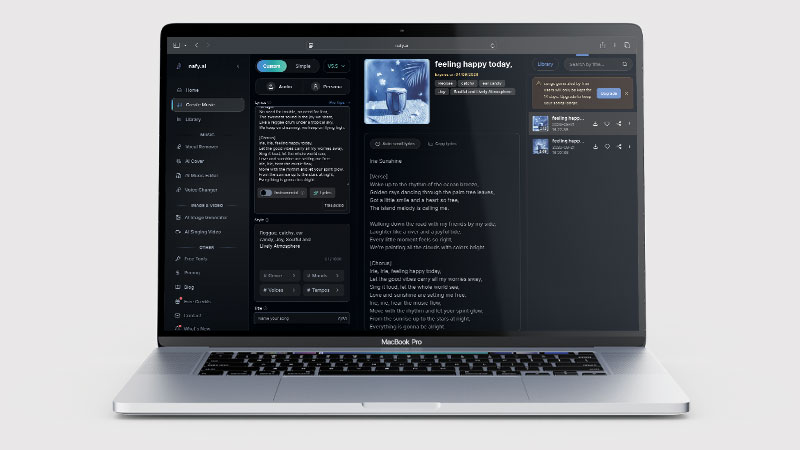
This review is a little different from most on this site. Before getting to the music, we spent time on Nafy AI’s own published documents — the terms, the commercial licence, the refund policy and the pricing page. What we found there matters more than any individual feature, because several of those documents contradict each other on the single question a paying customer most needs answered: whether you are actually allowed to use the music commercially.
What is Nafy AI?
Nafy AI is a browser-based AI music generator operated by BlueOrbit Technologies Limited, a company registered in Hong Kong (company number 78716780). The platform first appeared in late January 2026 and reached version 1.1.1 in May 2026, when it added a voice-cloning feature called Persona and a model it labels v5.5.
The interface is available in fourteen languages and the pitch is straightforward: describe the music you want in plain English, pick a few options, and get a full track back with sung vocals. No music theory, no DAW, no session musicians.
One detail worth noting early. Nafy AI’s own commercial licence states that it is “based on the open-source licenses of the underlying AI models” — an acknowledgement that the company did not build the models generating your music. It is packaging someone else’s technology. That is a perfectly legitimate business, and plenty of good products are built this way, but it does shape how much weight to give claims about proprietary neural architecture on the marketing pages.
What Can You Do With Nafy AI?
The feature list is broad for a platform this young:
- Text to Music — describe a mood, genre and tempo and get a complete track
- Lyrics to Song — paste your own words and have the platform build music around them
- AI Song Cover Generator — upload audio and shift it into a different genre while keeping the melody
- AI Music Extension — add bridges, extend outros or lengthen sections of an existing track
- AI Music Editor — regenerate a specific segment by timestamp without disturbing the rest
- AI Lyrics Generator — produce lyrics from a theme, across multiple languages
- AI Vocal Remover — separate vocals from a mixed track to leave an instrumental
- Persona — capture or upload your own singing voice and generate tracks with it
There are also four free utilities that do not require a subscription: a lyrics generator, a MIDI editor, an audio-to-MIDI converter and a song finder.
Nafy AI Pricing
All prices are in US dollars, so UK buyers should expect a small currency conversion on top and some month-to-month variation.
| Plan | Annual price | Songs | Commercial use? |
|---|---|---|---|
| Free | £0 | 3 per day | No |
| Basic | $149/yr (~$12.42/mo) | 250/month | See below |
| Standard | $299/yr (~$24.92/mo) | 1,000/month | See below |
| Pro | $599/yr (~$49.92/mo) | 2,400/month | See below |
Nafy AI presents itself as the budget option, but that only holds at high volume. Both Suno and Udio start their paid plans at $10 a month, which is less than Nafy’s cheapest paid tier at $12.42 — and that $12.42 rate requires committing to a full year up front. Month-to-month, Basic is closer to $14.90. Nafy only gains a price advantage at the top end, where Standard gives you 1,000 songs a month for around $25 against roughly $30 for comparable volume on the other two.
The Nafy AI Free Tier Is More Limited Than It Looks
Nafy AI markets itself as a free AI music generator. The free tier exists, but it is best understood as a demo rather than a usable plan:
- Three songs a day, on the older V3 model only, capped at four minutes
- You cannot download anything. Tracks stay on the platform
- No commercial use of any kind
- Files are deleted after 14 days
- Your creations are not private — the terms grant Nafy AI permission to “showcase, reproduce, or reference” tracks made on the free tier for promotional purposes
That last point deserves emphasis. On the free plan you are not simply using a limited product; you are supplying material the company may use in its own marketing. Nothing about that is hidden — it is stated plainly in the terms — but it is not mentioned on the pricing page, and most people will not read the terms.
The Documentation Contradicts Itself
This is the most significant finding of the review, and it is the reason we would hesitate before recommending a paid plan today.
1. The terms and the pricing page disagree about what “Basic” means. Nafy AI’s user agreement, last updated 27 February 2025, describes exactly two membership tiers: “Basic (Free): Create music for personal enjoyment only” and “Pro (Paid): Full commercial licensing included.” The pricing page sells four tiers, in which Basic is a paid plan costing $149 a year. So if you buy the Basic plan, the governing legal document defines your tier as the free, personal-use-only one. That is not a trivial wording slip — it is the contract that decides whether you may monetise your tracks.
2. The commercial licence excludes most paying customers. The licence document opens with: “This license is available exclusively to Nafy.ai annual subscribers.” Yet the pricing FAQ states that “All paying customers (subscriptions and Pay As You Go) receive full commercial rights.” Both cannot be true. On the licence’s own wording, monthly subscribers and pay-as-you-go buyers are not covered.
3. The pricing page contradicts itself on the same screen. The Basic plan’s feature list includes AI Music Extension, section editing, the vocal remover and model V4. Directly underneath, the FAQ asks “Why are extend, replace, and vocal remover unavailable on Basic Monthly?” and confirms the Basic tier excludes them along with V4. A prospective customer reading top to bottom gets two different answers within a single page.
4. The policies are stale. The privacy policy is dated February 2024 — predating the platform’s own launch by two years — and the terms date from February 2025. Neither reflects the four-tier pricing structure currently being sold.
None of this proves bad faith. The likeliest explanation is a small team that shipped fast, reused template legal documents and never revisited them as the pricing evolved. But the practical effect is the same: if a dispute ever arose about your right to monetise a track, the documents you would be relying on do not currently agree with one another.
The Training Data Claim Does Not Add Up
To Nafy AI’s credit, it publishes a table of the datasets it says its models were trained on — which is more transparency than Suno or Udio currently offer. The listed sources are FMA (Creative Commons audio), the Lakh MIDI Dataset, Slakh2100, MusicNet (classical recordings) and the OpenScore Lieder Corpus (public-domain art-song scores).
These are real, respectable, openly licensed research datasets. The difficulty is that they are mostly symbolic MIDI data, classical recordings and nineteenth-century song transcriptions. It is not plausible that a model trained solely on those sources produces contemporary pop vocals, rap delivery and radio-style mastering across fourteen languages. Read alongside the licence’s own reference to “the underlying AI models”, the more likely picture is that Nafy AI is a front-end over third-party models whose training data it does not control and cannot fully account for.
That matters because the commercial licence contains a warranty: Nafy AI “warrants that platform-generated music does not infringe third-party copyrights.” A warranty is only ever worth as much as the party standing behind it — in this case a company whose registered office is a single room in Sha Tin, Hong Kong, and whose terms nonetheless nominate UK law as governing. Enforcing that warranty from Britain would be an expensive and uncertain exercise.
Hands-On: We Made a Reggae Track
Documentation only tells you so much, so we signed up for the free tier and made a song. To keep it fair, we generated the lyrics in Nafy AI, then fed the same lyrics into both Nafy and Suno and compared the results.
What the free tier actually gives you
Signing up produced 8 credits. Generating lyrics is free and uses no credits, which is worth knowing — you can write and rewrite as much as you like before committing anything. Credits are spent only on the music, and one song cost 4 credits — so the free tier is realistically two attempts, not the three songs a day the pricing page implies. Each generation returns two variations to choose from, which is a sensible touch and matches what Suno does.
Almost immediately we were shown this warning: “songs generated by free users will only be kept for 14 days. Upgrade to keep your songs longer.” That confirms the terms we read earlier. There is no download button on the free tier, so after fourteen days the track is simply gone. If you make something you like, your only route to keeping it is to pay.
Speed: the weakest part of the experience
This is where Nafy AI struggles. The lyric generator is free to use but took noticeably longer than expected, and the track generation itself was slow. Running the same prompt through Suno was faster by a clear margin. If you like to iterate — generate, listen, tweak, regenerate — the waiting adds up quickly, and with only two free attempts you cannot afford many rounds.
The music itself — and a genuine surprise
We asked for a reggae track. Same lyrics into both tools, with prompts written to suit each platform’s style box.
| Nafy AI | Suno | |
|---|---|---|
| Tempo | Slower, relaxed groove | Noticeably faster |
| Genre feel | More authentically reggae | Less convincingly reggae |
| Vocals | Plenty of ad libs — sounded natural | Cleaner, more produced |
| Production | Slight reverb, a touch electronic | Tighter mix |
| Song structure | Bridge sounded like another chorus | Bridge sounded like another chorus |
| Generation speed | Slow | Much faster |
On this track, Nafy AI edged it. The slower pace suited the genre, and the ad libs gave the vocal a looseness that made it feel more like a real performance than a generated one. The slight reverb pushed it a little electronic, but the overall groove was more convincingly reggae than Suno’s faster take.
That is a real point in Nafy AI’s favour and worth saying plainly, because it cuts against much of what we found elsewhere. One caveat: both tools made the same structural mistake: the bridge in each version sounded like another chorus rather than a genuine change. That looks like a limitation of AI song generation right now rather than of either platform.
Second test: an EDM track
One track in one genre is not much to judge by, so we ran a second test in a completely different direction. This time we wrote the lyrics in ChatGPT rather than either platform, so neither tool had home advantage, and gave both the identical style description: “Electronic, EDM, soulful and lively atmosphere, danceable, catchy, 80–120 BPM, clear and melodious voice, female emotive voice.” The song was called Dance With Me.
Nafy AI came out punchier and more immediately danceable. The beat starts straight away, the vocal sits right on the tempo, and it lands from the first bar. The chorus drifts towards euro-dance, which suited the brief.
Suno went trance. It opens with a lighter beat, gradually layers a hi-hat over the female vocal, then lifts hard at the chorus. Catchy and anthemic, but a slower build — you wait for the payoff rather than getting it immediately.
Both tracks were genuinely good, and which you prefer is largely taste: instant impact versus a slow build. But the same pattern held as in the reggae test — Nafy’s vocals were the stronger of the two. Suno’s were fine; Nafy’s were better. Across two very different genres, that is the one thing that stayed consistent.
Same lyrics, same brief, two tools. Judge for yourself:
Feeling Happy Today — reggae
Nafy AI version · Suno version
Dance With Me — EDM
Nafy AI version · Suno version
What Are the Downsides of Nafy AI?
Nafy AI has four real problems. The free tier gives you two songs, not the open trial it appears to be, and generation is slow enough to notice. There are no free downloads at all, so anything you make on the free plan stays on Nafy AI’s servers and expires. Pricing is annual-only and works out dearer than Suno to start. And Nafy AI’s own documentation contradicts itself on credits and licensing, while its training-data claim does not stand up to arithmetic.
None of that is about the music, which is genuinely good — in our two tests Nafy AI beat Suno on vocals. The problems are all in how the product is packaged and described.
Nafy AI Review: Pros and Cons
Nafy AI Pros
- Nafy AI is better value at high volume — 1,000 songs a month for around $25
- Unusually broad toolset for the price, including vocal removal and stem-level editing
- Publishes its training data sources, which most competitors do not
- Voice cloning (Persona) is included rather than sold as an add-on
- Interface available in fourteen languages
- Free tier lets you hear the output quality before paying
- Genuinely good reggae output — beat Suno on our test track
- Natural-sounding vocal ad libs
- Two variations returned per generation
- Lyric generation is free and uses no credits
- Perpetual commercial rights for annual subscribers, surviving cancellation
Nafy AI Cons
- The Nafy AI terms, licence and pricing page contradict each other on commercial rights
- Terms define “Basic” as the free tier while the site sells Basic as a paid plan
- Commercial licence covers annual subscribers only, despite FAQ claims
- Free tier cannot download and grants Nafy AI promotional use of your tracks
- Noticeably slower than Suno to generate
- Free tier is really two songs, not the three a day advertised
- Refund window is 7 days and capped at 5 generated tracks
- Stated training datasets cannot account for the output the platform advertises
- Hong Kong company, UK governing law — awkward to enforce either way
- Launched February 2026, with no independent hands-on reviews yet
Who Is Nafy AI For?
Nafy AI makes most sense for hobbyists and experimenters — people who want to hear what AI music generation can do, are working on personal projects, and are not depending on clear commercial rights. At three free songs a day it costs nothing to find out whether the output suits you.
It makes least sense for anyone putting music into work that earns money: YouTube channels, client videos, podcasts, advertising. Not because the tool cannot produce usable audio, but because the paperwork underpinning your right to use it commercially is currently inconsistent. And since Suno and Udio both start cheaper, you are not even trading money for that uncertainty.
Nafy AI Limitations
The refund policy is tighter than “no questions asked” suggests. You have seven days, but only if you have generated five tracks or fewer. Five tracks is not many when you are testing a music generator — on the free tier alone you would burn through that in under two days. Anyone properly evaluating a paid plan will exceed the refund threshold almost immediately.
The track record is short. Nafy AI launched in February 2026. On the AI directory There’s An AI For That it holds an average of 3.5 out of 5 from just six ratings, and its domain authority sits at 25. Searching for independent coverage returns directory listings and a paid press release, but no hands-on review from anyone who has actually used it for a project. Being new is not a flaw in itself, but it does mean there is no track record on billing, support responsiveness or whether the service will still exist in a year.
The marketing copy is heavily over-optimised. The phrase “ai music generator” appears dozens of times across the homepage in constructions no human would write — “our ai music generator’s neural systems”, “this ai music generator lets you”. Two section headings misspell “Music” as “Muisc”. This is cosmetic, but it tells you where the effort has gone: into ranking on Google rather than into the customer-facing detail. That is consistent with what we found in the legal documents.
How Does It Compare to Suno and Udio?
| Nafy AI | Suno | Udio | |
|---|---|---|---|
| Launched | February 2026 | 2023 | 2024 |
| Free tier | 3 songs/day, no download | Generous, downloads allowed | Limited monthly credits |
| Entry paid price | $12.42/mo (annual only) or ~$14.90 monthly | $10/mo | $10/mo |
| Commercial rights | Contradictory documentation | Paid plans, copyright grey area | Paid plans, restrictions apply |
| Voice cloning | Included | Limited | No |
| Independent reviews | None found | Extensive | Extensive |
| Our rating | 7.5/10 | 8/10 | See review |
The honest summary is that Nafy AI competes on breadth of features and on high-volume pricing, while Suno and Udio compete on maturity, on a lower entry price, and on knowing where you stand legally. The budget-option framing does not survive contact with the actual numbers: unless you are generating hundreds of tracks a month, both competitors cost less.
Is Nafy AI Good? Our Verdict
Yes, the music is good — we scored Nafy AI 7.5/10. In our two hands-on tests it beat Suno on vocals, which surprised us. The score reflects packaging rather than output: two free songs, no free downloads, annual-only billing, and documentation that contradicts itself on credits and licensing.
Nafy AI surprised us. On our reggae test it produced a better track than Suno — slower, groovier, with vocal ad libs that made it sound like a performance rather than an output. The model is genuinely capable, and that is not something we expected to write.
The problem is everything around the music. It is slow to generate, the free tier gives you two attempts rather than the advertised three a day, nothing can be downloaded, and anything you make disappears after fourteen days unless you pay — and paid plans start at $149 a year, billed annually. A platform selling commercial music licences needs its terms, its licence and its pricing page to agree on who is allowed to sell what. Nafy AI’s do not. Until the company defines “Basic” the same way in both its contract and its shop, and resolves whether monthly subscribers hold commercial rights, anyone using these tracks in paid work is standing on unclear ground.
7.5 out of 10 reflects that split. The music is genuinely good — good enough to beat Suno on vocals in both our tests — and that is what the score is mostly rewarding. What holds it back is everything around the model: slow generation, a stingy free tier and paperwork that contradicts itself. Most of it is fixable, and we would happily revisit this review if it is sorted. For now, if you just want to hear what it can do, the free tier costs nothing. If you need tracks you can keep and sell, use Suno.
Nafy AI Score Breakdown
| Output quality | 8.5/10 | Beat Suno on vocals in both our tests |
| Ease of use | 7/10 | Simple to drive, but slow and only two free attempts |
| Features | 8.5/10 | Voice cloning, vocal remover, stem editing, 14 languages |
| Value for money | 6.5/10 | Dearer than Suno to start, annual-only, no free downloads |
| Overall score | 7.5/10 | Capable model, difficult packaging |
Nafy AI Review Rating: 7.5/10
Best for: Hobbyists and curious experimenters who want to hear what AI music generation sounds like at no cost, and who are not relying on keeping or selling the results.
Not ideal for: Anyone who needs to work quickly, download their tracks, or put AI music into monetised work.
Read more about how we test AI tools.
Frequently Asked Questions
Is Nafy AI worth it?
Hard to recommend on price. Nafy AI is annual-only at around $12.42 a month, which is dearer than Suno to start, and there are no free downloads at all. The music is genuinely good, so the value question is whether the output justifies the packaging.
Is Nafy AI free?
There is a free tier giving you three songs a day on the older V3 model. However, you cannot download your tracks, you cannot use them commercially, files are deleted after 14 days, and the terms allow Nafy AI to use what you create in its own promotional material. It is best treated as a preview rather than a free plan you could work with.
How much does Nafy AI cost?
Paid plans are billed in US dollars: Basic at $149 a year, Standard at $299 a year and Pro at $599 a year. Paying monthly instead costs roughly 20% more. A pay-as-you-go credit option is also available for occasional users.
Can I use Nafy AI music commercially?
This is genuinely unclear, which is our main reservation about the platform. The commercial licence says it applies exclusively to annual subscribers, while the pricing FAQ says all paying customers get full commercial rights. Separately, the user agreement defines “Basic” as the free, personal-use-only tier — even though Basic is sold as a paid plan. If you need commercial rights, take an annual plan and ask support to confirm your position in writing before you publish anything.
Who owns Nafy AI?
BlueOrbit Technologies Limited, registered in Hong Kong under company number 78716780, with a registered office in Sha Tin. The terms of service nominate UK law as governing, which is an unusual pairing and would make any dispute complicated for a British customer.
Can I get a refund from Nafy AI?
Within seven days of your first purchase, provided you have generated no more than five tracks. That second condition is the restrictive one — five tracks is very little when evaluating a music generator, so most people testing the service properly will lose refund eligibility within a day or two.
Is Nafy AI better than Suno?
Not on the evidence available. Nafy AI offers more tools — voice cloning and vocal removal are included — and works out slightly cheaper at very high volumes. But Suno is actually cheaper to start with ($10 a month against $12.42), does not require an annual commitment, and we rated it 8/10 as a far more established platform with a clear position on what you may do with your tracks. For paid or commercial work, Suno remains the safer choice.
Nafy AI Alternatives Worth Considering
- 🎵 Suno — the most polished and accessible AI music generator, rated 8/10
- 🎶 Udio — stronger on audio fidelity, with a more restrictive free tier
- 🎜️ Mozart AI — aimed at musicians who want control rather than one-click generation

James is an SEO and content specialist with over 12 years’ experience, and tests AI tools so everyday people don’t have to. WhatAITools.co.uk covers honest, no-jargon reviews to help you find the right tool for your needs.
Leave a Reply