⚠️ Affiliate Disclosure: This post is not an affiliate associated review. It may become one in the future and this disclosure will reflect that. This does not affect my reviews and I only recommend tools I genuinely believe in.
Most AI tool reviews you’ll find are written by sites that earn money when you sign up, and many of them never used the tool. That doesn’t make every review worthless. It means you need to know what to look for. This is the checklist I use, and the one I hold WhatAITools to.
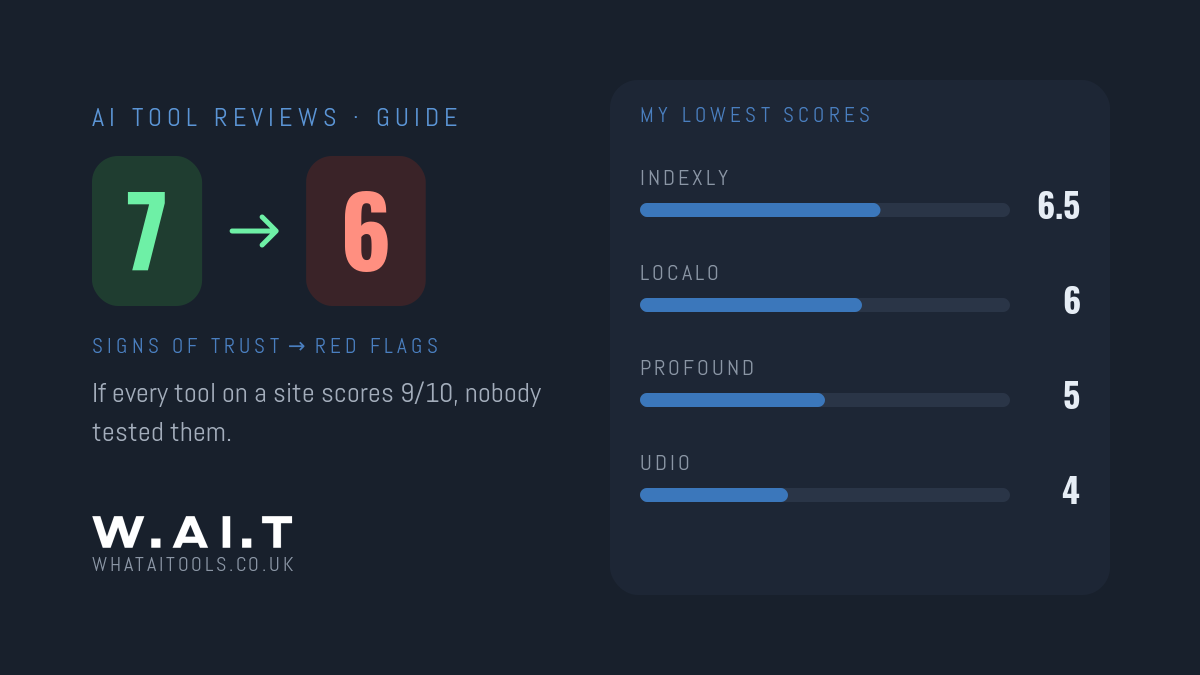
Quick answer: an AI tool review site is trustworthy if it shows proof it used the tool, publishes how it scores, gives some tools low scores, dates its prices, and tells you when it earns a commission. If every tool on a site scores 9 out of 10, nobody tested them.
Why AI Tool Reviews Are Hard to Trust
Three things make AI tool reviews unusually unreliable. Most review sites earn affiliate commission, so a sign-up is worth more than an honest “don’t bother”. AI tools change their prices and plans every few months, so a review that was right in spring can be wrong by autumn. And it’s now easy to produce a review without touching the tool, by rewording the vendor’s own feature list with AI.
None of that is visible at a glance. The signs below are.
7 Signs an AI Tool Review Site Is Trustworthy
- It shows proof of testing. Screenshots of the tool in use, the prompts the reviewer gave it, and specific things that went wrong. A real test always finds something the marketing page doesn’t mention.
- It publishes how it scores. You should be able to find the criteria behind a score, such as output quality, ease of use, features and value, and see the reasons for each one.
- Some scores are low. A site that tests honestly will rate some tools badly. If every score is 8 or 9, the scores aren’t telling you anything.
- Prices are dated and labelled. Look for a “checked on” date, the currency, and whether a price is monthly or billed annually. Undated prices are often out of date.
- It tells you about commissions. An affiliate link isn’t a problem on its own. A hidden one is. Look for a clear disclosure near the links, not just in the footer.
- It says what it didn’t test. A trustworthy site will tell you when it hasn’t used a tool, rather than ranking it anyway.
- A real person is accountable. A named author with a background you can check is more likely to stand behind what they publish.
Red Flags to Watch For
- “Best” lists of 30 or 50 tools. Nobody tests 50 tools properly for one article.
- No downsides. Every tool has weaknesses. A review without any is an advert.
- The same features in the same order as the vendor’s website. That’s a rewrite, not a review.
- Fake urgency. Countdown timers, “only today” deals and “prices going up soon” belong to sales pages.
- Paid placements without a label. If a tool is “featured” or “sponsored”, that should be said plainly.
- A free plan the vendor dropped months ago. If a review gets the basic price wrong, it probably wasn’t checked recently.
How I Apply This Checklist to WhatAITools
I’d rather show you than tell you, so here is how WhatAITools measures up against its own checklist.
- Low scores: I scored Profound 5/10 and Udio 4/10 after testing them. When my tests turn up problems, scores come down: I recently lowered Indexly from 7.5 to 6.5.
- Tools I won’t test: I refused to connect any of my sites to BabyLoveGrowth because of how its backlinks work, and I said so in a BabyLoveGrowth alternatives page instead of reviewing it. There’s also a page of tools I looked at but didn’t review.
- Method: my how I test and score page explains the four criteria behind every score.
- Commissions: some links on the site are affiliate links, and my affiliate disclosure explains how that works. Affiliate status never changes a score.
- Dated prices: reviews show a “Last updated” date, and I check prices on vendor pages and say whether they’re in pounds or dollars.
I don’t always get it right. When I find a mistake, I fix it and update the date.
A Quick Test You Can Do Yourself
Before you trust any review, including mine, check one fact yourself. Open the tool’s own pricing page and compare it with the review. If the review’s price, free plan or plan names don’t match, treat everything else in it with care.
Frequently Asked Questions
Are AI tool review sites paid by the tools they review?
Many earn affiliate commission when you sign up through their links, and some sell featured placements. That isn’t always a problem, but a trustworthy site discloses it clearly and still gives low scores when a tool deserves them.
How can I tell if a review was written without using the tool?
Look for specifics only a user would know: screenshots, the exact prompts used, problems found and how long things took. A review that only lists features, in the same order as the vendor’s website, probably came from the website.
Is WhatAITools independent?
WhatAITools is run by me, James Huntington, and every tool I review is signed up for and tested by hand. Some links are affiliate links, which I disclose, and vendors can’t pay for a review or a score.
Are AI tool directories the same as review sites?
No. Directories list thousands of tools so you can find them, usually with a description from the vendor. Review sites test a smaller number of tools and tell you how well they actually work. Directories are useful for discovering tools; reviews are for deciding whether to pay.
Every tool I review is signed up for and tested by hand. See how I test and score.
Leave a Reply